All-time French Open Venues
There are differing opinions about the venues for the French Closed Championships, which was held from 1891 until 1924 and was the precursor to today's French Open. The source for the facts presented here is the book "Tennis: a cultural history" by Heiner Gillmeister. The tournament was open only to French nationals and other players licensed with French tennis clubs. In 1925, the French Championships became open to all amateur players from all countries.
Île de Puteaux, Paris: 1891, 1893, 1895, 1897, 1899, 1901, 1903, 1905, 1907
The first French Closed Championships held on the courts of the club of the
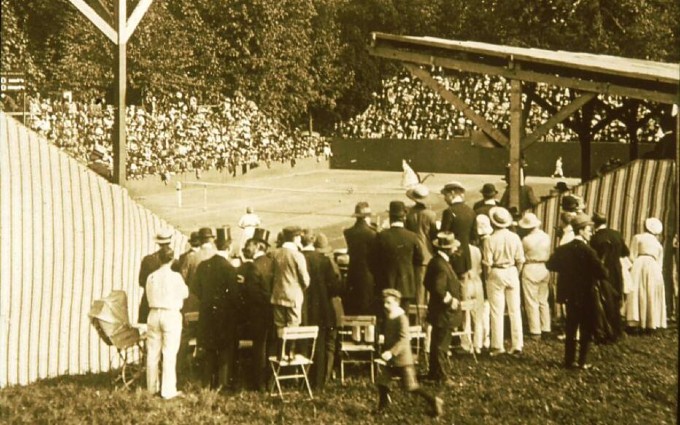
Cercle des Sports de Île Puteaux. The club's ten-sand grounds were situated on the island of Puteaux in the Seine near Bois de Boulogne. Unlike the grass courts of Great Britain, the surface was formed by laying fine river sand on a firm cushion of building rubble and broken bricks. This ensured rapid drainage during rains. The surface was later upgraded to the classic red clay used in modern competitions. The Île de Puteaux was the venue for the tennis events at the
1900 Olympic Games. It was here that Britain's
Charlotte COOPER won the first-ever women's Olympic gold medal.
Racing Club de France, Paris: 1892, 1894, 1896, 1898, 1900, 1902, 1904, 1906, 1908, 1910-1914, 1920-1924, 1926
In the early years, the two Parisian sports clubs, the
Racing Club de France and
Île de Puteaux, which had the largest number of courts and spectator stands, became the primary venues for the first tennis tournaments.
The Croix-Catelan tennis complex, belonging to the Racing Club de France, was located in the heart of the picturesque Bois de Boulogne in western Paris. This created a unique, elite atmosphere of country relaxation amid nature and attracted a wealthy public who came with interest to watch the fashionable and popular sport. In the 1890s and early 1900s, competitions were held on the courts of these clubs in turn, culminating in the last tournament at the Racing Club de France in 1926, which was won by the legendary French tennis players
Henri COCHET and
Suzanne LENGLEN.
Societe Athletique de la Villa Primrose, Bordeaux: 1909

One of the oldest and most prestigious sports clubs in France was founded in 1897 in the provincial city of Bordeaux. That same year, the prestigious Bordeaux International tournament (also known as the Coupe de la Villa Primrose) was launched and held regularly until the start of the Open Era. The city's wealthy families, famous for their affluence, fell in love with the fashionable English sport and invested their money in tennis. Their efforts led to the prestigious competition of 1909 being held in Bordeaux - the only time the tournament went outside the borders of Paris. Many important events took place on the club's courts. Still, the most memorable were the French Championship in 1909 and the France-Spain match with the "Mousquetaires" in 1922. Today, the Villa Primrose complex is located in the heart of Bordeaux and is a true green oasis in the city. The central court of the facility is surrounded by stands that can accommodate several hundred spectators, creating a unique, cozy club atmosphere of the old European aristocratic sport.
Stade Francais, Saint Cloud: 1925, 1927
In 1925, French Championships became open to best foreign players and held on clay courts at Stade Francais in Saint Cloud Park, Paris.
In 1912-1914, 1920, 1921 and 1923 local courts were the venue of World Hard Court Championships, sometimes called another precursor to the French Open. It was tournament, which was opened to all nationalities unlike the French Closed Championships, and it was part of a series of three world championships.
The historic base at Saint Cloud Park is still in operation. Spectators are happy to come to the former royal grounds, with centuries-old trees that create a special, elite and cozy atmosphere.
Roland Garros, Paris: 1928 - present
Roland Garros Stadium was built in 1928, before France began the first Davis Cup defense against US Team. After sensation win over America in 1927, the French Tennis Federation and the Government combined efforts to release three hectares of land near the Porte dAuteuil and in 1928, new tennis stadium, named for Roland Garros, a pioneer aviator and World War I hero, became venue of the Davis Cup and French Open.
Now tennis complex consists of twenty courts, including three large-capacity arenas - Court Philippe Chatrier (formerly Court Central), Court Suzanne Lenglen (formerly Court A) and Court 1 with 3,800-seat capacity, which was opened in 1980.
Roland Garros Stadium Map
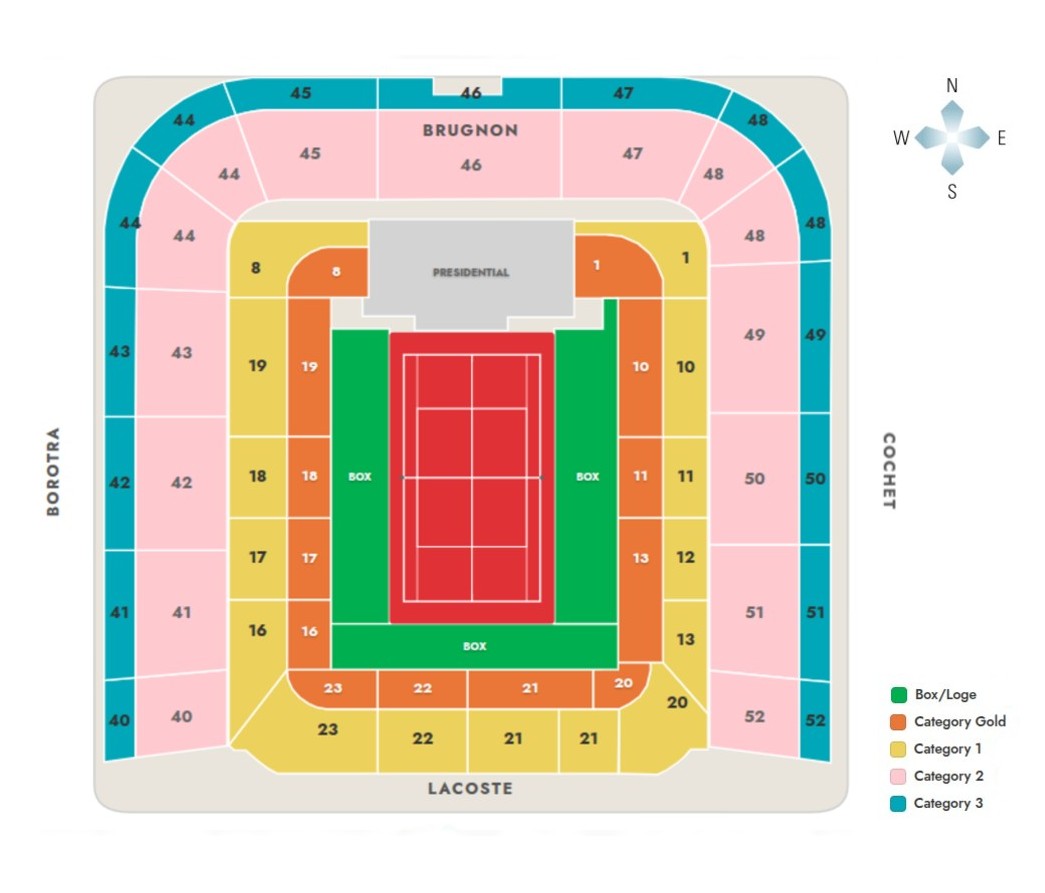
Court Philippe Chatrier
Court Philippe Chatrier was built in 1928 and is the principal venue of the Roland Garros complex, with a seating capacity of 14,840 (reduced from 15,166 in 2010 to accommodate new press boxes). In May 2001, the arena, formerly known as Court Central, was renamed to honor Philippe Chatrier (2 February 1926 - 22 June 2000), longtime president of the French Tennis Federation. In 2008, Roland Garros stadium celebrated its 80th anniversary and former stands A, B, C and D of the Court Philippe Chatrier were renamed in honor of the famous Musketeers of French tennis:
Jacques BRUGNON (stand A),
Jean BOROTRA (stand B),
Rene LACOSTE (stand C) and
Henri COCHET (stand D).
Traditionally, the Court Philippe Chatrier has a red clay surface made of crushed brick. It is the slowest court among the Grand Slam tournaments.
Tribune Lacoste (South) is located behind the player's back on one side. The stand is traditionally where the most shade is found during the day.
Tribune Brugnon (North) is on the opposite side of Lacoste, behind the other baseline. Here are the president's box, VIP loges and the players' boxes.
Tribune Borotra (West) is along the sideline. The sun sits behind this stand after 4 pm, making it ideal for evening sessions.
Tribune Cochet (East) is located opposite the Borotra stand. This is where the players' benches, the umpire's chair, and the best positions for photographers are designated.
Court Suzanne Lenglen
Court Suzanne Lenglen is the second arena of Roland Garros. It was inaugurated in 1994 and, originally named "Court A", it later gained status as Court Suzanne Lenglen in honor of
Suzanne LENGLEN, the French tennis star of the 1920s.
he stadium with a capacity of 10,068 spectators has a red clay surface with an underground irrigation system, the first of its kind, to control moisture levels within its surface. In 1994, two main stadiums were connected by a walkway called Allee
Marcel BERNARD, in honor of the first French Open Men's Singles champion after World War II. In 2024, a retractable roof was installed on the second-largest court at Roland-Garros Stadium.
Court Suzanne Lenglen Seating Map
The Suzanne Lenglen Court often indicates orientation using the cardinal points (North, South, West and East) or staircase numbers (escaliers).
Loges. The closest seats to the court for VIPs. Spectators are seated one meter away from the players as they approach the towel box.
Category 1. Seats are located in the lower tier and in the first rows of the upper tier.
Category 2. Mid-level rows in the upper tier (upper circle) of all four stands provide a balanced panoramic view of the entire court, allowing a good view of both the net and the back line.
Category 3. Seats are located in the outermost rows of all four corner sectors of the stadium. Ticket prices here are the most affordable for visitors.
 SLAM HISTORY